November 24, 2026
Quantum computing uses qubits to solve problems classical computers cannot. Learn how quantum computing hardware works and why cryogenic testing is key to moving quantum chips from lab to fab.
Quantum computing is a way of processing information with quantum bits, or qubits, instead of classical bits. A qubit can hold a combination of 0 and 1 at once, and groups of qubits can be entangled. These properties let a quantum computer work through certain hard problems in ways a classical computer cannot.
Quantum computing hardware is also hard to build and harder to test. Many solid-state qubit technologies, including superconducting and some semiconductor spin-qubit devices, operate at cryogenic temperatures. These devices must be characterized under cold, low-noise conditions before they are integrated into larger systems. This article explains how quantum computing works, what the hardware looks like, and how cryogenic testing helps move quantum chips from lab to fab.
Quantum computing works by placing qubits in controlled quantum states, letting those states interact, and then measuring the result. Superposition lets each qubit represent a weighted mix of 0 and 1. Entanglement links qubits so the state of one depends on the others. Quantum algorithms use interference between these states to make correct answers more likely when the qubits are measured.
A classical bit is always either 0 or 1. A qubit can exist in a superposition of both until it is measured, when it settles into a single value. A register of classical bits holds one value at a time. A register of qubits is described by amplitudes across every possible value at once, and that is the source of a quantum computer’s potential speedup on specific problems.
Coherence is the practical limit. Qubits are sensitive to heat, vibration, stray magnetic fields and electrical noise, and any of these can collapse the quantum state before a calculation finishes. Much of quantum hardware engineering is about protecting coherence long enough to compute.
Classical computers process bits in definite states and remain the right tool for most computing work. Quantum computers suit specific problem types, such as simulating molecules or searching very large solution spaces. They are expected to work alongside classical systems, not replace them.
| Feature | Classical computing | Quantum computing |
| Basic unit | Bit (0 or 1) | Qubit (superposition of 0 and 1) |
| How units combine | Independent bits | Qubits can be entangled |
| Best suited for | General-purpose computing and data processing | Simulation, optimization and some cryptography problems |
| Operating temperature | Room temperature | Near absolute zero for many qubit types, including superconducting and spin qubits |
| Sensitivity to noise | Low | High; error correction is an active research area |
| Maturity | Mature and mass produced | Research and early commercial stage |
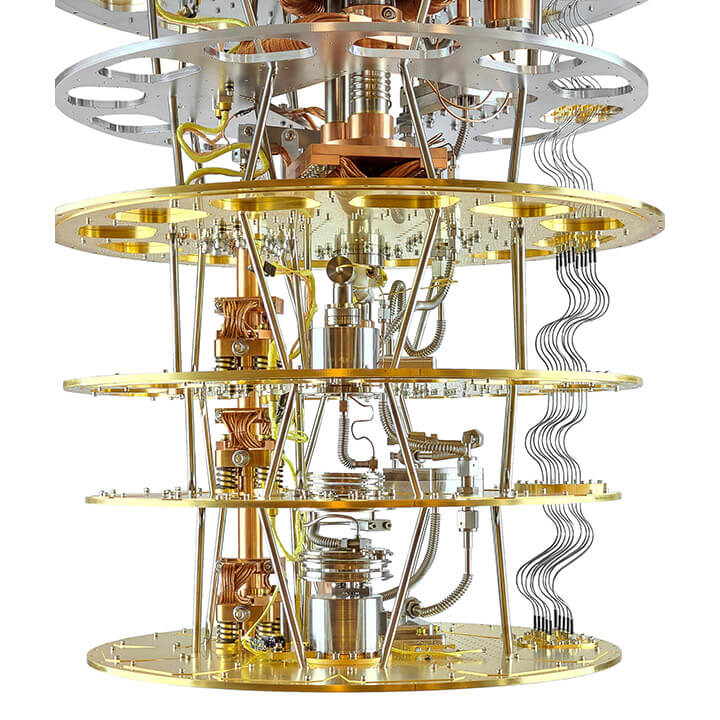
Quantum computing hardware is the physical system that creates, controls and reads out qubits. It includes the quantum processor, the control and readout electronics, the wiring that carries signals in and out, and the cryogenic system that keeps the processor cold enough to work.
Many leading qubit designs are built with semiconductor manufacturing methods. Superconducting qubits are patterned from thin superconducting films on wafers. Spin qubits are formed in silicon devices that resemble advanced transistors. Because these chips are fabricated on wafers, quantum developers face familiar semiconductor questions about process control, yield and device-to-device variation.
The main challenges are scale, noise and data. Useful machines need far more qubits than today’s systems, and every added qubit is another source of error. Device performance varies from wafer to wafer and die to die. Teams also need more measurement data than slow, manual cryogenic test cycles can produce.
Quantum computing is set to revolutionize a multitude of scientific and engineering domains, offering advancements in personalized medicine, precise weather forecasting, improved battery technologies, and ultra-secure encryption, among other potential applications.
Most of these uses are still at the research stage. Today, quantum computers are used mainly for research, algorithm development and early experiments in chemistry, materials science and optimization. Broad commercial use depends on larger and more reliable machines.
A related class of machines, superconducting computers, aims to take classical computing to the exascale level. Logic families such as RQL (reciprocal quantum logic) and RSFQ (rapid single flux quantum) use quantum effects and superconducting connections to perform classical computing functions with high speed and efficiency. Like many quantum computers, they must operate close to absolute zero.
Superconducting digital computing is being investigated for its potential to deliver high computational throughput with lower energy per operation than conventional room-temperature electronics
Cryogenic testing is essential because many quantum chips only behave as designed at temperatures near absolute zero. A superconducting qubit measured at room temperature says little about how it will perform in a quantum computer. Engineers need to test devices under the same cold, low-noise conditions in which they will operate.
Heat is noise. At normal temperatures, thermal energy disturbs qubit states almost immediately. Superconducting qubits also need their circuits cooled below the superconducting transition temperature of their materials. Cooling to the millikelvin range removes most thermal energy and gives qubits enough coherence time to complete a calculation.
Cryogenic testing gives designers the data they need to iterate. Measurements at low temperature confirm operating parameters, reveal manufacturing defects and show how performance varies across a wafer. Many test methods mirror those used for conventional semiconductors, but they must be carried out at extreme cold with tight control of vibration, magnetic fields and signal noise.
Quantum chip testing is the measurement of quantum devices to confirm that they work and to characterize how well they work. It ranges from basic electrical checks, such as resistance and continuity, to RF measurements of resonators and qubit properties at millikelvin temperatures.
Testing usually happens in stages. Room-temperature checks screen out obvious defects. Wafer-level tests at about 4 K measure superconducting properties and device parameters across many dies. The most promising dies then move to a dilution refrigerator for full qubit characterization. Correlating results across these stages helps teams predict cold performance from faster, lower-cost measurements.
Wafer-level testing measures many devices on a full wafer before it is diced, which produces the data volume needed for statistics and process control. Chip-level testing measures individual dies, often at lower temperatures, to characterize devices in detail before they go into a system.
| Factor | Wafer-level quantum testing | Chip-level quantum testing |
| What is tested | Full wafers, many dies per cooldown | Single dies or small sets of dies |
| Typical temperature | About 4 K | 4 K down to millikelvin |
| Main purpose | Screening, yield and process feedback | Detailed device and qubit characterization |
| Data volume | High, supports statistical analysis | Lower, with deeper data per device |
| FormFactor examples | HPD IQ3000 | HPD IQ2000 Base, Flatiron™ dilution refrigerator |
The goals are the same: confirm function, find defects and feed results back to the fab. The conditions are different. Quantum chips must be tested near absolute zero, with magnetic shielding, very low vibration and careful thermal anchoring of every signal line. Each measurement is slower and more expensive as a result, which is why automation matters.
FormFactor offers cryogenic test and measurement systems and services across the quantum development cycle, from chip-scale research to automated wafer probing. The aim is to give quantum chip developers faster access to cryogenic data so they can iterate on their designs.
With cryogenic test services, teams can screen for manufacturing defects at cryogenic temperatures, correlate room-temperature data with cryogenic performance, pre-characterize qubits to reduce QPU bring-up time and characterize superconducting materials. Customers can collect high-volume data with the 4 K wafer prober or qualify qubit devices near deployment conditions with ADR cryostats that reach below 50 mK.
Quantum computing is a method of computation that uses qubits, which can exist in superpositions of 0 and 1 and can be entangled with each other. These properties let quantum computers approach certain problems, such as molecular simulation, in ways classical computers cannot.
Qubits are the basic units of quantum information. Their quantum properties give a quantum computer its power, and their sensitivity to noise is the main obstacle to building larger machines.
Quantum computing hardware is the physical system that runs quantum algorithms: the quantum processor, its control and readout electronics, the wiring and the cryogenic system that keeps the processor cold.
Superconducting and spin qubits are fabricated on wafers with semiconductor processes. That makes wafer-level testing, yield analysis and process control as important for quantum chips as for conventional ICs.
Many quantum devices only work near absolute zero. Testing them at those temperatures is the only way to confirm they will perform as designed inside a quantum computer.
Common equipment includes cryogenic wafer probers, chip-scale cryogenic probe stations, dilution refrigerators, cryostats, cryogenic probes and probe cards, and measurement and automation software.