As quantum technologies move from fundamental research toward scalable hardware platforms, the ability to perform reliable measurements at millikelvin temperatures has become essential for both academic and industrial laboratories.
Traditional dilution refrigerators, however, were not designed for rapid experimental iteration. Many systems require large laboratory footprints, complex sample exchange procedures, and lengthy cooldown cycles that slow development cycles and limit experimental throughput.
FormFactor’s Flatiron™ Dilution Refrigerator was developed to address these challenges. The system brings millikelvin measurement capability into a compact, benchtop platform designed to simplify sub-kelvin electrical and optical experiments while helping researchers move more quickly from device development to validated results.
Why Faster Millikelvin Testing Matters
Quantum devices such as superconducting qubits, spin qubits, single-photon detectors, and cryogenic electronics typically operate at temperatures far below one kelvin. At these temperatures, thermal noise is minimized and quantum behavior can be measured and controlled with greater precision.
For researchers developing these technologies, millikelvin testing is an essential step in the development process. Engineers use these environments to characterize device performance, evaluate new materials, and test emerging architectures for quantum computing, sensing, and communication.
In practice, conventional dilution refrigerator systems can slow this work. Sample exchange often requires extensive disassembly, and large installations can make experiments difficult to modify or repeat quickly.
Flatiron was designed to address these challenges by improving accessibility and reducing the time required to move between experiments.
Introducing the Flatiron™ Dilution Refrigerator
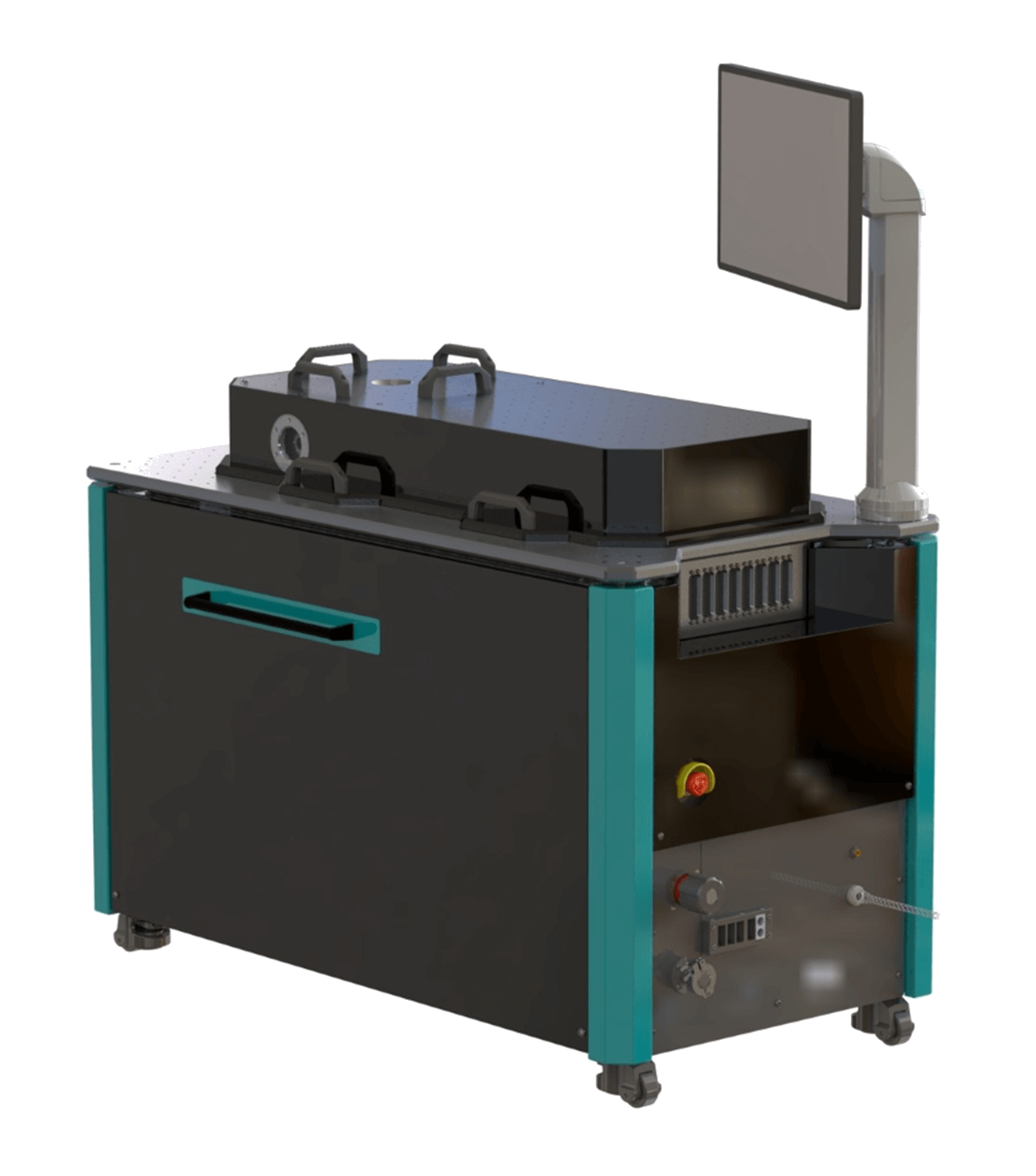
The Flatiron Dilution Refrigerator is a benchtop millikelvin platform that enables advanced cryogenic experiments in a system designed to integrate easily into modern laboratories.
Its horizontal architecture provides direct access to the sample stage and simplifies experimental setup compared with traditional vertically oriented dilution refrigerators.
For research teams developing quantum hardware, this design shortens the time between experiments and reduces the effort required to change samples or reconfigure measurement setups.
Key Features of the Flatiron Platform
- Millikelvin performance in a compact system
Flatiron reaches base temperatures of approximately 30 millikelvin, supporting a wide range of quantum devices and low-temperature materials measurements.
The system’s horizontal benchtop design allows direct access to the sample stage through the top plate, reducing the need to remove multiple vacuum cans or radiation shields during device changes.
- Designed for lab integration
With a footprint of roughly 150 cm by 80 cm, the system can sit alongside optical tables and standard laboratory equipment without requiring major facility modifications.
- Optical and electrical measurement capability
Four cryogenic windows enable optical and electro-optical measurements at sub-Kelvin temperatures, supporting experiments that combine electrical and photonic device testing.
Accelerating Quantum Hardware Development
As quantum technologies mature, development workflows increasingly require faster iteration and repeatable millikelvin measurements to validate new devices and architectures.
Thomas Fries, Vice President and General Manager of FormFactor’s Emerging Growth Business Unit, had this to say:
Millikelvin measurements are critical not only for fundamental research, but increasingly for fast, cost-effective validation of quantum hardware. With Flatiron, we make sub-kelvin measurements easier to access and integrate into existing labs.
By simplifying experimental setup and improving sample access, the Flatiron Dilution Refrigerator allows researchers to run more experiments and evaluate new device concepts more quickly.
As part of FormFactor’s broader cryogenic portfolio, Flatiron supports electrical, RF, and optical measurements at extremely low temperatures in a compact system designed for everyday laboratory use.
FAQ: Dilution Refrigerators and Quantum Testing
What is a dilution refrigerator used for?
A dilution refrigerator is a cryogenic system capable of reaching extremely low temperatures, often below 50 millikelvin. These temperatures are required for experiments involving superconducting qubits, cryogenic electronics, quantum sensors, and other devices that rely on quantum mechanical effects.
Why are millikelvin temperatures important for quantum devices?
Quantum states are highly sensitive to thermal energy. Cooling devices to millikelvin temperatures reduces thermal noise and allows researchers to observe and control quantum behavior more reliably.
What makes a benchtop dilution refrigerator different?
Traditional dilution refrigerators are often large, vertically oriented systems that require significant laboratory infrastructure. Benchtop systems are designed to be more compact and accessible, allowing easier integration into existing labs and faster experimental setup.
What experiments require optical access at cryogenic temperatures?
Optical access enables experiments involving photonic quantum devices, single-photon detectors, optically controlled qubits, and hybrid systems that combine optical and electrical measurements.
See Flatiron Live at APS
Visit FormFactor at Booth 1620 during the APS Global Physics Summit, March 16–20, 2026, in Denver, CO, to see a live demonstration of the Flatiron™ Dilution Refrigerator and learn how it enables faster, more accessible millikelvin measurements.