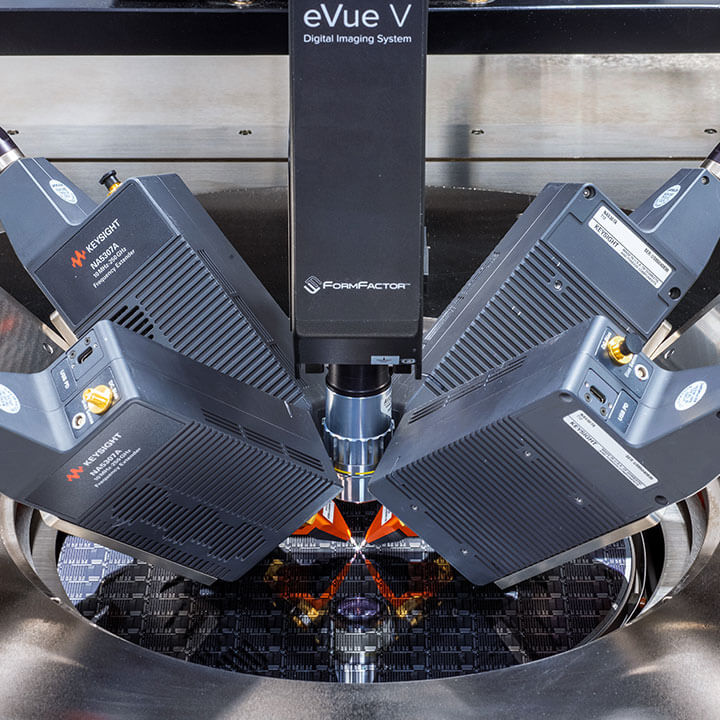
As RF test requirements continue to evolve, engineers are under pressure to validate performance earlier, faster, and with greater confidence. From 5G RF testing to emerging mm-Wave applications, today’s devices are operating at higher frequencies, with tighter tolerances and far more complexity than even a few years ago.
RF wafer test sits right in the middle of this shift. By enabling on-wafer RF test before packaging, teams can catch performance issues earlier, improve yield, and avoid expensive downstream surprises. But getting accurate, repeatable RF measurements at the wafer level isn’t easy, and most teams run into the same set of challenges.
Let’s take a closer look at where things get difficult, and what to watch for when building or scaling an RF test strategy.
What Is RF Wafer Test and Why Does It Matter?
At its core, RF testing measures how a device behaves at radio frequencies, things like gain, noise, linearity, and impedance. When that testing happens at the wafer level, it gives engineers an early look at performance, before devices are packaged and harder (and more expensive) to fix.
That early visibility is especially important for:
- 5G and mm-Wave devices pushing into higher frequency bands
- RF front-end modules and filters
- Automotive radar, IoT, and other high-reliability applications
If you can trust your wafer-level data, you can make better decisions earlier. If you can’t, everything downstream becomes riskier.
7 Key Challenges in RF Wafer Test
- Maintaining Measurement Accuracy at High Frequencies
Once you get into mm-Wave, small problems stop being small.
At higher frequencies, signal wavelengths shrink, and suddenly things like tiny discontinuities, slight misalignment, or even cable routing start to matter a lot more than you’d expect. The setup you’re using to measure the device can easily influence the results.
Teams typically run into:
-
- Signal loss that eats into measurement margin
- Sensitivity to probe placement and contact quality
- Parasitics introduced by the test setup itself
At that point, the test system isn’t just observing performance, it’s affecting it.
Why it matters:
If your measurements aren’t accurate, you’re either chasing problems that don’t exist or missing ones that do. Neither ends well.
What helps:
Treat the entire RF path as a single system. Accuracy improves when probing, cabling, and instrumentation are designed and validated together, not pieced together.
- Calibration Complexity and Drift
Calibration always matters in RF, but at higher frequencies, it becomes harder to get right and harder to keep stable.
On-wafer calibration adds another layer of complexity. You’re not just calibrating the instrument, you’re calibrating all the way out to the probe tip, under real contact conditions.
Over time, things shift:
-
- Temperature changes affect measurements
- Probe contact varies slightly from touchdown to touchdown
- Mechanical drift creeps in
And while frequent recalibration helps, it also slows everything down.
Why it matters:
If calibration isn’t stable, your data isn’t consistent. And if your data isn’t consistent, it’s tough to trust comparisons across wafers, lots, or time.
What helps:
Focus on system stability. The more stable your environment and probe setup, the longer your calibration holds, and the less often you need to stop and reset.
- Scaling RF Test from R&D to High-Volume Manufacturing
What works in the lab doesn’t always survive contact with production.
In R&D, engineers can tweak setups, take their time, and work around limitations. In production, none of that is realistic. Everything needs to run fast, repeatably, and with minimal intervention.
That’s where many RF test strategies break down:
-
- Manual steps that don’t scale
- Setups that are too sensitive for production environments
- Test times that are fine for characterization, but too slow for volume
Trying to force a lab setup into manufacturing usually leads to bottlenecks.
Why it matters:
If RF test doesn’t scale, it slows down your entire production ramp.
What helps:
Plan for scale early. The best RF test solutions support both detailed characterization and automated, high-throughput production testing.
- Probe Performance and Contact Reliability
At RF frequencies, the probe interface has to do a lot more than just make contact, it has to preserve signal integrity.
Over time, a few things start to creep in:
-
- Probe tips wear down
- Contact resistance varies
- Alignment becomes harder as geometries shrink
And the tricky part? These changes are often gradual. You don’t always notice right away when measurements start drifting.
At smaller nodes, even slight misalignment or inconsistent contact can show up as performance variation.
Why it matters:
It becomes hard to tell whether you’re seeing real device behavior or just variability in the measurement setup.
What helps:
Use probe solutions designed specifically for RF and put checks in place to catch contact degradation early, before it starts affecting your data.
- Thermal Effects on RF Performance
RF devices are sensitive to temperature, more than many teams expect.
Parameters like gain and noise figure can shift as temperature changes, and during testing, devices can heat up quickly depending on the measurement conditions.
Common challenges include:
-
- Self-heating during test
- Temperature differences across the wafer
- Difficulty holding a stable temperature during fast test cycles
If temperature isn’t controlled well, measurements won’t reflect how the device actually performs in the field.
Why it matters:
You risk qualifying devices under conditions that don’t match real-world operation.
What helps:
Accurate, responsive thermal control built into the test environment, not treated as an afterthought.
- Increasing Complexity of 5G and mm-Wave Devices
RF devices used to be simpler. That’s no longer the case.
With 5G and beyond, devices are handling:
-
- Multiple frequency bands
- Wider bandwidths
- More complex architectures like beamforming
That translates into more measurements, more test conditions, and more opportunities for something to go wrong.
At the same time, test time can’t just keep increasing, especially in production.
Why it matters:
You need to test more, but you don’t have more time to do it.
What helps:
Flexible RF test solutions that can handle multi-port, multi-band measurements efficiently, without turning test into a bottleneck.
- Automation and Throughput Limitations
At some point, manual RF testing hits a wall.
Automation is the only way to keep up with volume, but integrating RF measurement into automated workflows isn’t trivial.
Teams often run into:
-
- Coordination issues between wafer handling and measurement systems
- Variability introduced during automated probing
- Tradeoffs between speed and measurement quality
Automation helps, but only if the system is designed to support it from the start.
Why it matters:
Throughput directly impacts cost, delivery timelines, and overall production efficiency.
What helps:
End-to-end integration. When wafer handling, probing, and RF measurement are designed to work together, automation becomes an advantage, not a risk.
How RF Wafer Test Impacts Yield and Time-to-Market
All of these challenges show up in two places that matter most: yield and time-to-market.
If measurements aren’t reliable, yield analysis becomes unclear. If testing is slow or inconsistent, production ramps take longer than planned.
On the flip side, when RF wafer testing is done right:
- Problems are caught earlier
- Good devices aren’t discarded unnecessarily
- Production moves faster with fewer surprises
Choosing the Right RF Test Solution
There’s no single fix for RF test challenges, but the right approach makes a big difference.
Look for solutions that bring everything together:
- Accurate measurements at high frequencies and into mm-Wave
- A clear path from R&D to high-volume manufacturing
- Stable probing and thermal control
- Built-in support for automation and throughput
FormFactor’s RF wafer test solutions are designed with this system-level approach in mind, combining precision probing, thermal subsystems, and validated measurement integrations through programs like MeasureOne.