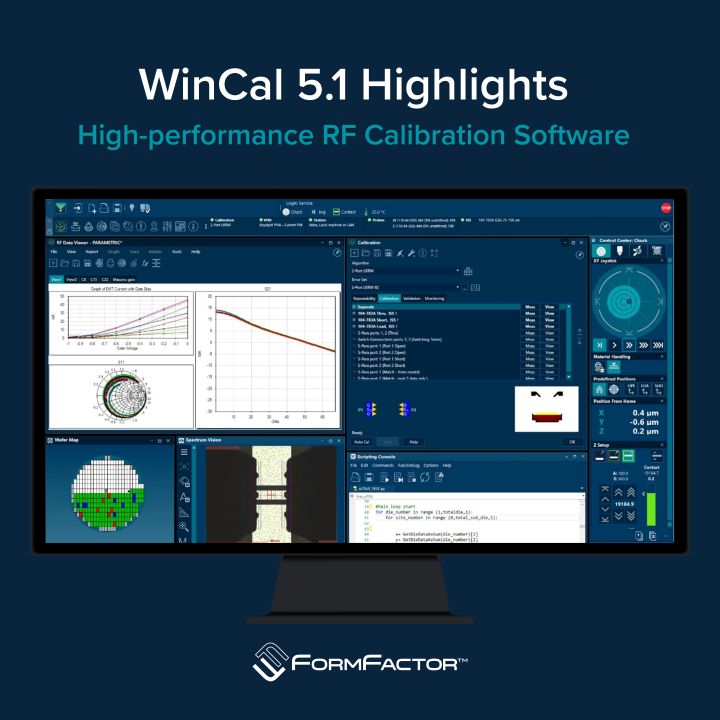
As RF and mmWave devices move to higher frequencies and tighter layouts, calibration at wafer test has become a real bottleneck. Traditional calibration methods weren’t built to handle intra-probe coupling and crosstalk, especially in dense, multi-port probe configurations. The result is measurement data that can look correct, but doesn’t always reflect what the device is actually doing.
WinCal® 5.1 RF calibration and measurement software introduces new capabilities specifically designed to close that gap, helping engineers trust their on-wafer RF data as device complexity continues to rise.
What’s New in WinCal 5.1: Modal Calibration for Crosstalk Correction
The most important addition in WinCal 5.1 is Modal Calibration, a new calibration method that directly addresses coupling effects inside the probe, something earlier WinCal versions and conventional calibration techniques simply couldn’t correct.
Modal Calibration uses a 32-term error model to remove crosstalk between closely spaced signal paths, delivering more physically accurate results for differential and mixed-mode measurements. This is a meaningful step forward for engineers working with:
- 4-port GSSG probe setups, where signal spacing is inherently tight
- Differential and mixed-mode measurements at mmWave frequencies
- Applications like 6G research and 77 GHz automotive radar
- High-frequency probing when combined with InfinityXF™ probes up to 250 GHz
Importantly, this new correction capability doesn’t require new hardware or complicated procedures. Modal Calibration is built directly into WinCal’s existing SOLT workflow. Engineers simply enable the option in a 4-port calibration plan, and WinCal automatically performs the additional measurements and computes both standard and modal-augmented error sets in a familiar, one-click process
New Instrument Support and Better Measurement Traceability
WinCal 5.1 also expands compatibility and usability beyond calibration itself.
A new driver for Rohde & Schwarz ZNL VNAs resolves calibration transfer issues seen in earlier releases, improving stability during both raw and corrected measurements. This makes WinCal 5.1 a more reliable choice for teams standardizing on ZNL instruments.
Another new improvement is better traceability. WinCal 5.1 now embeds VNA stimulus settings and error set information directly into the measurement data. This makes it much easier to understand how a dataset was generated, whether you’re reviewing results days later or sharing data across teams.
Clearer Reporting and Stronger Support for Automation
Reporting has also been refined in WinCal 5.1. Corrected measurement reports now automatically reference the error set used during calibration, reducing ambiguity and manual checks. Performance-related options allow users to streamline large measurement runs without sacrificing stability
For automated environments, WinCal 5.1 expands remoting capabilities, making it easier to integrate advanced calibration and correction into external test frameworks and custom scripts. This allows teams to apply higher-order calibration consistently, whether in the lab or across automated wafer test setups.
A Practical Step Forward for On-Wafer RF Testing
WinCal 5.1 isn’t just an incremental update. By introducing Modal Calibration and strengthening instrument support, traceability, and automation, this release directly addresses measurement challenges that have become unavoidable at high frequencies and tight probe geometries.
For engineers working at the edge of RF and mmWave device performance, WinCal 5.1 provides a more reliable foundation for extracting physically meaningful, trustworthy data at wafer test.
For more details on the new WinCal 5.1, download the WinCal 5.1 Highlights Product Update.